
Profile
The course is a comprehensive, hands-on training experience designed to guide students from foundational robotics principles to building a fully functional autonomous robot. The program emphasizes real engineering practices, practical tool usage, structured problem-solving, and exposure to modern robotics systems used in academic research and global competitions.
*All required licensed or paid software tools will be provided to participants throughout the program.
By the end of the program, participants will be able to design, simulate, build, program, and test a working robot equipped with autonomous capabilities. The curriculum integrates mechanical design, electrical system development, embedded programming, Python for robotics, ROS fundamentals, GPS/vision-based navigation, and research methodology.
This initiative is tailored to prepare students for advanced robotics work, competitive engineering teams, and early-stage research. Special pathways include:
- UIU Students: Upon successful completion, students become eligible for direct internship opportunities with the UIU Mars Rover Team. ( Terms and conditions applied)
- External Participants: Eligible students will be offered free membership opportunities with CAIR, subject to interview. ( With an interview procedure )
Learning Objectives
- Understand the interdisciplinary foundations of robotics across mechanical, electrical, and computational domains.
- Demonstrate proficiency in 3D modeling and simulation for robotic structures.
- Design and assemble functioning electrical systems for robotics applications.
- Program microcontrollers using C/C++ and implement control algorithms.
- Utilize Python for simulation, data handling, and introductory AI tasks.
- Develop and test autonomous behavior using sensors, GPS input, and vision-based navigation.
- Apply basic ROS workflows including nodes, topics, messages, and data visualization.
- Integrate odometry, sensor fusion, and path-planning concepts into practical systems.
- Conduct structured scientific research and present project outcomes effectively.
- Produce a complete robot project suitable for portfolios, competitions, or research entry.
Why Choose This Program?
- Mentorship from award-winning robotics practitioners
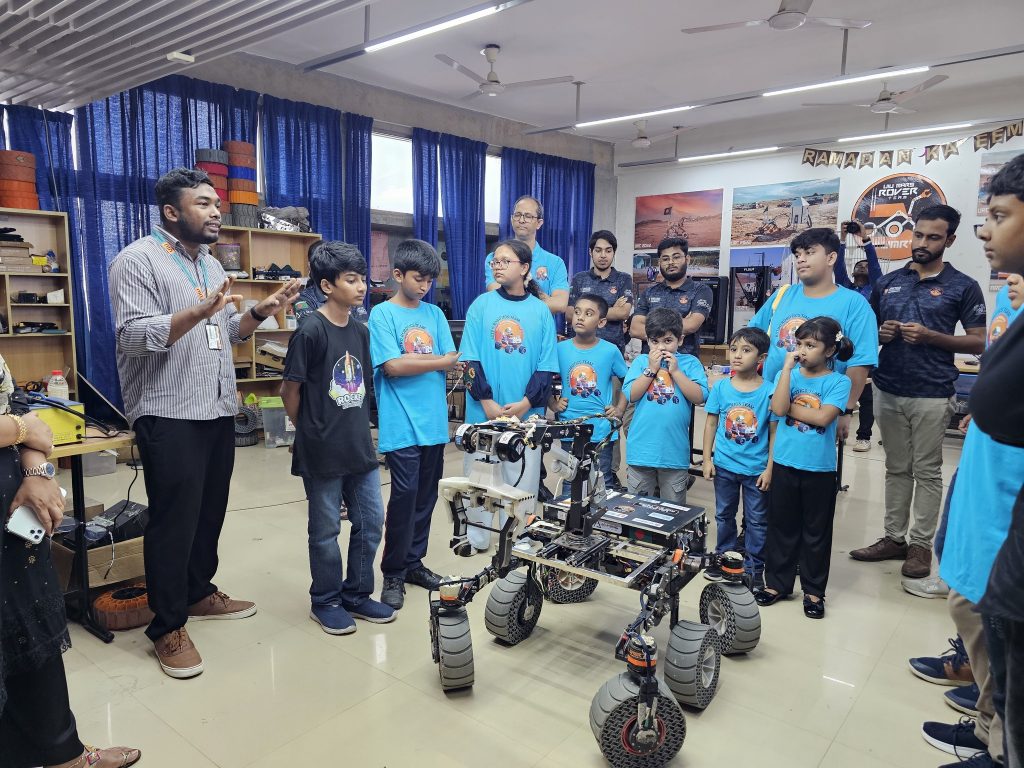
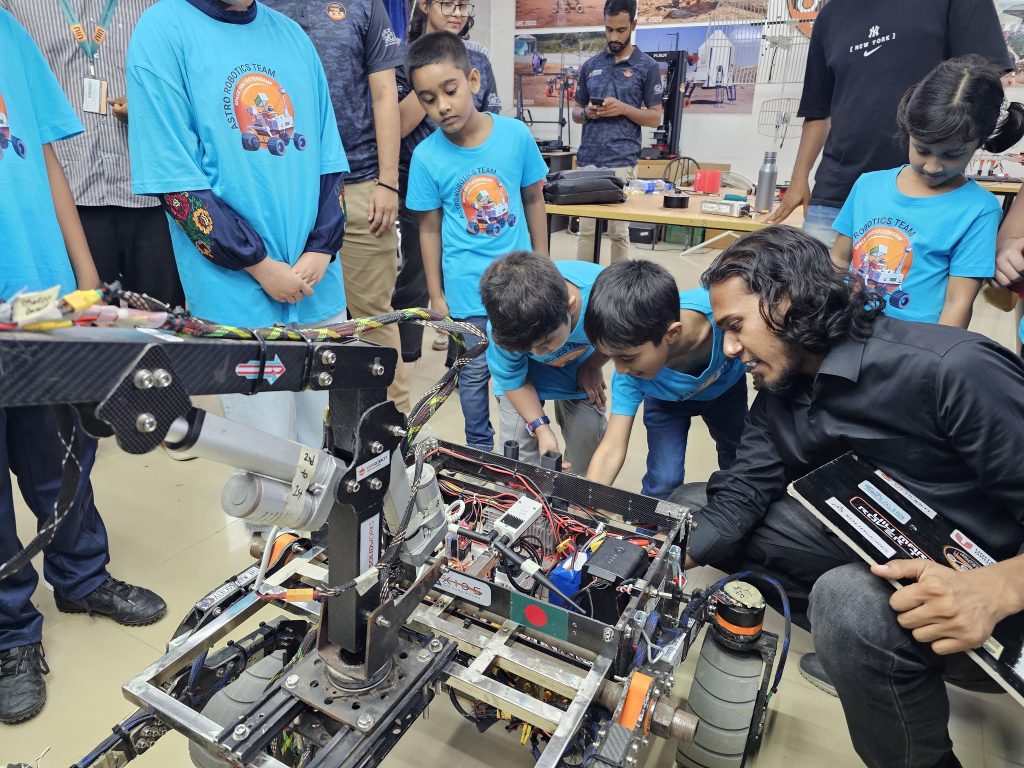
- Access to real hardware, tools, and testing environments
- Project-driven, industry-aligned learning experience
- Exposure to cutting-edge robotics domains including space, underwater, and aerial systems
- A complete robot to showcase beyond the classroom
- A certification that reflects practical competence rather than theory alone
- Direct pathways to internship or membership opportunities for eligible participants
- State-of-the-art robotics lab with tools, sensors, and hands-on hardware access from the very first class at United International University.
Program Outcomes
Graduates of this program will be able to:
- Design and model robotic systems from first principles
- Use modern 3D CAD and simulation software
- Build and debug real electronic circuitry
- Program embedded systems and develop control algorithms
- Implement autonomous behaviors
- Work with ROS as a beginner-to-intermediate user
- Build a portfolio-ready robotics project
- Enter competitive robotics teams or pursue research pathways
- Engage confidently in multidisciplinary engineering problem-solving
Terms & Conditions
- UMRT internship opportunities are subject to completion and evaluation.
- External CAIR membership opportunities require an interview.
- ALL UIU Terms & Conditions and disciplinary rules are included.
Instructor,
Md Abid Hossain
Mentor, UIU Mars Rover Team
Mentor, UIU Rescue Rover Team
Advisor, Team Poseidon’s Code
Instructor,
Sudipto Mondal
Mentor, UIU Mariner
Mentor, UIU Ariel Rover Team
Expertise in robotics, drones & embedded systems.
Mentors,
Md Mosfiqur Rahman
Team Lead, UIU Mars Rover
Sheikh Shakib Hossain
Autonomous SubTeam Lead, UIU Mars Rover Team
Shaif Al Shad
Science SubTeam Lead, UIU Mars Rover Team
Tawsif Turabi
Electrical, UIU Mars Rover Team
Bootcamp Structure Summary (by Month)
| Month–Module Structure | ||
|---|---|---|
| Month | Month Title | Modules Covered |
| 1 | Foundations & Mechanical Systems | Module 1: Foundations of Robotics
Module 2: Mechanical Design |
| 2 | Electronics, Embedded Systems & Python | Module 3: Electrical Systems & Hardware
Module 4: Embedded & High-Level Programming |
| 3 | Linux, ROS, Autonomous Systems & Navigation | Module 5: Autonomous Systems & ROS
Module 6: Navigation |
| 4 | Advanced Robotics, Research & Final Integration | Module 7: Special Topics & Research
*** Final Project Development |
| Key Focus Areas by Month | |
|---|---|
| Month | Key Focus Areas |
| Foundations & Mechanical Systems |
|
| Electronics, Embedded Systems & Python |
|
| Autonomous Systems, Linux & ROS Navigation |
|
| Advanced Robotics, Research & Final Integration |
|
Bootcamp Structure (Class by Class)
Module 1: Foundations of Robotics – C[1]
| Introduction to Robotics & Project Selection |
|---|
| Class 1 |
|
Module 2: Mechanical Design – C[2, 3, 4]
| Principles of Mechanical Design |
|---|
| Class 2 |
|
| 3D Modeling Simulation | |
|---|---|
| Class 3 | Class 4 |
|
|
Module 3: Electrical Systems & Hardware – C[5, 6]
| Electrical Design Essentials | |
|---|---|
| Class 5 | Class 6 |
|
|
Module 4: Embedded & High-Level Programming – C[7, 8]
| Embedded Programming (C/C++) |
|---|
| Class 7 |
|
| Python for Robotics |
|---|
| Class 8 |
|
Module 5: Autonomous Systems and ROS – C[9, 10]
| Introduction to ROS |
|---|
| Class 9 |
|
| Sensor Integration in ROS |
|---|
| Class 10 |
|
Module 6: Navigation – C[11, 12, 13]
| GPS-Guided & Vision-Based Navigation |
|---|
| Class 11 |
|
| Odometry based Navigation |
|---|
| Class 12 |
|
| Advanced Navigation |
|---|
| Class 13 |
|
Module 7: Special Topics & Research – C[14, 15, 16]
| Special Topics in Robotics |
|---|
| Class 14 |
|
| Research Methodology |
|---|
| Class 15 |
|
| Final Project Update |
|---|
| Class 16 |
|
Course Assignment Distribution
| Table 1: Assignment Timeline by Class & Module | |||
|---|---|---|---|
| Assig. No. | Class Point | Module Coverage | Assessment Scope |
| 1 | End of Class 4 | Module: Mechanical Design & 3D Modeling (Classes 2–4) | 3D robot model, mechanical simulation, exported fabrication files |
| 2 | End of Class 8 | Module: Electrical Systems + Embedded & Python Programming (Classes 5–8) | Electrical circuit build, microcontroller input/output tasks, C/C++ control logic, basic Python robotics tasks |
| 3 (Final) | End of Class 13 (Viva in Class 14) | Module: Autonomous Systems, ROS, Navigation, GPS/Vision (Classes 9–13) | Autonomous routine, ROS node/topic implementation, navigation demo (line/GPS/vision), documentation |
| Assignment Distribution by Month | |||
|---|---|---|---|
| Month | Coverage | Assignment | Associated Modules |
| 1 | C [1, 2, 3 4] | Assignment 1 | Mechanical Design, 3D Modeling & Simulation |
| 2 | C [5, 6, 7, 8] | Assignment 2 | Electrical Systems, PCB Basics, Embedded C/C++, Python Robotics |
| 3 | C [9, 10, 11, 12, 13] | Assignment 3 (Final) | Autonomous Systems, ROS, Odometry, GPS Navigation, Vision Navigation |
| 4 | C [14, 15 16] | Final Project + Viva | Special Topics, Research Methodology, Final Project Troubleshooting |
Certification Requirements
To qualify for certification, participants must meet the following criteria:
- ≥ 75% Assignment Completion
- ≥ 80% Attendance
- ≥ 75% Project Competence (based on rubric)
UIU students are eligible for a 10% program discount. (20,000 tk) (one time 18,000 BDT)
Mentorship Support
Each project team will be assigned a dedicated mentor from the UIU Mars Rover Team (UMRT) for technical and academic guidance throughout the bootcamp. Mentors will function as engineering advisors, supporting teams in weekly progress reviews, design validation, troubleshooting, and ensuring adherence to industry-standard development practices. This mentorship structure enables participants to receive direct expert support, strengthens project quality, and enhances overall learning outcomes through continuous, personalized supervision.
Final Project Requirement
Each participant is required to design, develop, and present a complete robot incorporating:
- A fully 3D-designed and printed mechanical structure
- Functional electronic circuitry with safe wiring practices
- C/C++ program controlling robot behavior
- At least one autonomous capability (e.g., GPS navigation, image-based navigation, ROS integration)
- Supporting documentation including simulation files, codebase, and test results
A formal evaluation and viva session will assess design rationale, implementation quality, and autonomous functionality.
The final project will be carried out in teams consisting of 3–5 members. Each team will collaborate on mechanical design, electronics, programming, and autonomous system integration, following real-world engineering workflows.



Blogs
November 2019

Why Learn Python- Top Reasons 2020
Python is everywhere. If you haven’t been living under a rock for the past 5-7 years you must have heard of python in one way or another. It is the largest growing high-level and interpreted programming language to-date. Learning Python makes you eligible for even more jobs in the market compared to C++ or Java. The average Python developer in the US (2019) earns an average yearly salary of slightly more than $120k. In addition to the lucrative job [...]